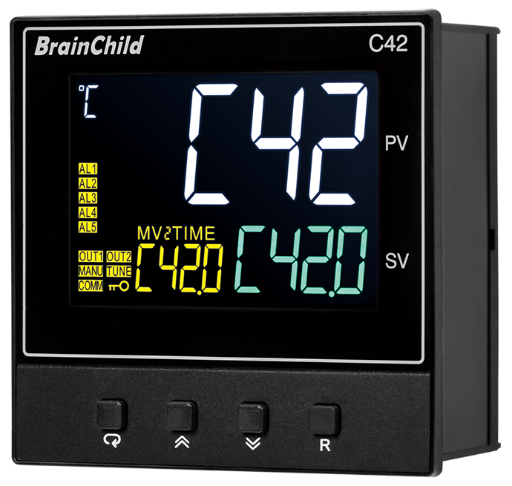
In plastic injection molding equipment, mold temperature stability directly affects dimensional accuracy, surface quality, and cycle consistency. The C42 controller supports Fuzzy Logic + PID, Heat-Cool control, 200 ms fast sampling, Auto-Tuning, Soft Start, alarms, event inputs, RS-485, retransmission, and remote setpoint, helping manufacturers build a more stable, responsive, and integration-ready temperature control system.
Why Does Plastic Injection Molding Equipment Need Precise Temperature Control?
1
Mold Temperature Affects Product Consistency
If mold temperature is unstable, it can cause shrinkage variation, dimensional inconsistency, and surface defects that directly affect product quality.
2
Heating and Cooling Must Be Coordinated
Plastic injection molding systems often require both heating and cooling. If they are not coordinated properly, overshoot, oscillation, and cycle instability can occur.
3
Stability and Efficiency Matter Together
The system must not only control temperature accurately, but also reduce setup time and improve cycle consistency to support stable mass production.
Common Challenges in Plastic Injection Molding Temperature Control
Unstable Temperature Control
When mold temperature is unstable, it can lead to dimensional variation, surface defects, and inconsistent product quality, ultimately affecting yield and process stability.
Difficult Heat-Cool Coordination
During heating, cooling, and thermal load changes, poor control response can lead to overshoot, oscillation, and slow recovery, making machine setup more difficult.
Time-Consuming Setup
Frequent changes in molds, materials, and process conditions can significantly increase setup and optimization time if the controller does not support fast tuning.
Limited System Integration
When abnormalities occur or integration with higher-level systems is required, limited alarm, protection, and communication functions can restrict equipment management and future expansion.
Smart Temperature Control Solution with C42
By implementing the C42, plastic injection molding equipment can evolve from simple temperature control into a more complete process control node. The most direct benefit is improved mold temperature stability, which supports better product consistency and process repeatability. For machine builders, Heat-Cool control, event inputs, and communication functions enable a more integrated and capable control architecture.
More Stable Control
Fuzzy PID reduces overshoot and oscillation for more stable mold temperature control.
Faster Tuning
Auto-Tuning helps reduce setup time during initial startup and mold changeover.
Faster Response
A 200 ms sampling rate is ideal for injection molding processes with fast thermal load changes.
Better Protection
Supports multiple alarms, heater break/short detection, and failure transfer functions.
Integrated Heat-Cool Control
Heat-Cool PID improves coordination between heating and cooling actions.
More Flexible Integration
Supports event inputs, RS-485, retransmission, and remote setpoint for flexible integration.
If you are looking for a plastic injection molding temperature control solution that combines precise mold temperature control, stable heat-cool performance, equipment protection, and communication integration, contact us today to find the control solution that best fits your application needs.